



Filming in Indonesia
FILMING IN INDONESIA
Filming in Bali, Jakarta and the Indonesian Archipelago with NEEDaFIXER
Filming in Indonesia means shooting in the world’s largest archipelago — more than 17,000 islands along the equator, home to smoking active volcanoes, emerald rice fields, centuries-old temples and the last wild komodo dragons on Earth. From the glass towers of Jakarta to a remote island in Raja Ampat, Indonesia offers a diverse range of locations that few countries can match on a single production.
It is also a country where preparation decides everything. Foreign productions need a national film permit, a valid visa for every crew member and careful customs clearance for filming equipment. As a production company with fixers, producers and crews across the region, NEEDaFIXER handles the entire process, so your team lands with permits approved, equipment cleared and locations locked. Here is everything filmmakers need to know about filming in Indonesia.
Why Choose Indonesia for Your Film Production?
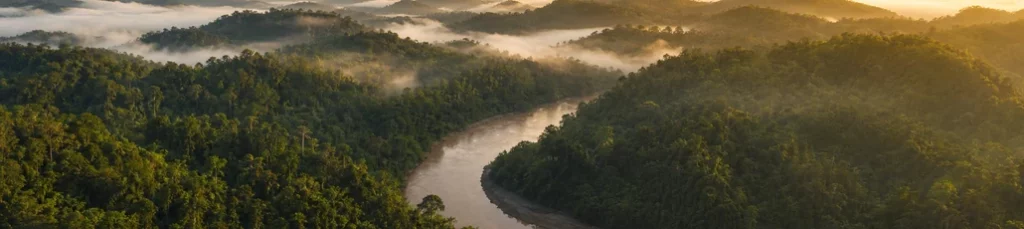
Unique natural assets.
More than 50 national parks, several with UNESCO World Heritage status, protect wildlife found nowhere else — komodo dragons, orangutans, birds of paradise.
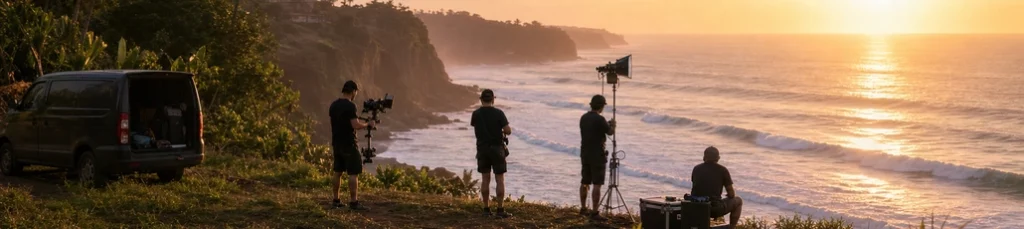
Culture and heritage.
Over 300 ethnic groups, Hindu and Buddhist temples, and a living culture of ceremony and craft give documentary and drama crews centuries of story to work with.
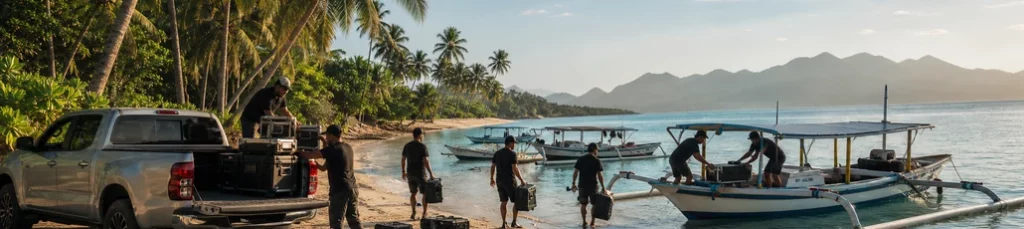
Competitive costs.
Local crew members, equipment rental and accommodation are significantly cheaper than in Australia, Japan or Western Europe.
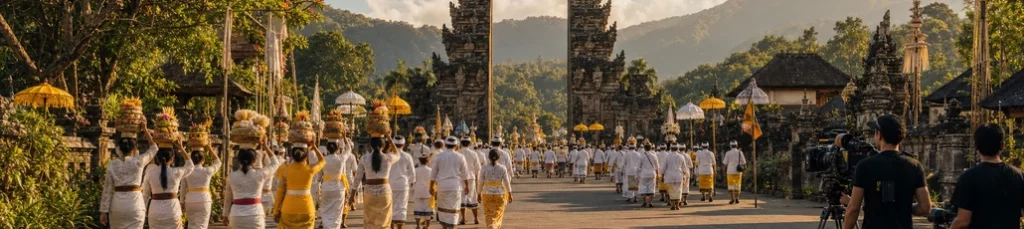
Warm hospitality.
Communities are welcoming to film crews, and fixers with real local knowledge open doors that would stay closed to outsiders.
Experienced local talent.
A fast-growing creative economy means capable directors of photography, gaffers, drone operators and production coordinators are available in Jakarta and Bali.
Location Scouting: Key Places for Filming in Indonesia
BALI
The busiest hub for foreign productions: rice terraces, waterfalls, clifftop temples and volcanic beaches within a two-hour drive. Ubud, Tanah Lot and Uluwatu, plus the deepest pool of English-speaking crew and equipment outside Jakarta — the natural base for the eastern islands.
JAKARTA
The capital delivers the urban end: elevated highways, colonial-era Kota Tua, the old harbour of Sunda Kelapa, vast markets and the Central Jakarta skyline. The country’s production centre, with the largest inventory of equipment, studios and crew — as Michael Mann’s Blackhat showed.
KOMODO NATIONAL PARK
A UNESCO World Heritage Site between Sumbawa and Flores: pink-sand beaches, savannah hills, manta-filled channels and the komodo dragon itself. Filming needs a special conservation permit on top of the national permit, plus boats, rangers and tight logistics.
BOROBUDUR & CENTRAL JAVA
Borobudur Temple — the largest Buddhist monument in the world — rises near Magelang, while the ancient Hindu temples of Prambanan stand outside Yogyakarta. Both are protected sites with their own permissions, and both have hosted major shoots, including Java Heat.
MOUNT BROMO & EAST JAVA
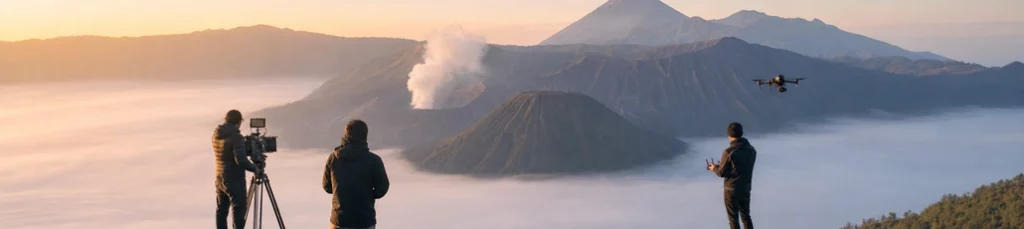
Mount Bromo — a smoking crater rising from a sea of volcanic sand — and the blue-flame crater of Ijen give productions scenes from another planet within a day’s drive of Surabaya’s international airport.
SUMATRA, KALIMANTAN & RAJA AMPAT
For wildlife and expedition filming: Gunung Leuser in Sumatra (orangutans, tigers, elephants, rhinos), the rivers of Kalimantan, and the reefs of Raja Ampat in West Papua — filmed for Netflix’s Our Planet — holding the richest marine biodiversity on Earth. Each needs additional permissions.
Interested in our work? Browse our portfolio to see the exceptional productions we’ve delivered for clients around the world.

Productions Filmed in Indonesia
International filmmakers have been drawn to the Indonesian archipelago for decades, and the locations keep pulling productions back. A few landmark titles show the range of what filming in Indonesia can look like.
Eat Pray Love (2010)
The Julia Roberts hit filmed its entire final act in and around Ubud, Bali — rice terraces, healer’s compounds and beach scenes that put Balinese locations in front of a global audience and triggered a tourism wave the island still rides today.
Java Heat (2013)
Conor Allyn’s action thriller, starring Kellan Lutz and Mickey Rourke, shot on location in Yogyakarta and Magelang — including scenes at Borobudur Temple itself — proving large-scale action can be staged at Indonesia’s most protected heritage sites with the right permits and local partners.
Blackhat (2015)
Michael Mann brought Chris Hemsworth to Jakarta for the finale of his cyber-thriller, shooting at Soekarno-Hatta Airport, the old harbour of Sunda Kelapa, Tanah Abang and Lapangan Banteng — a masterclass in filming a major studio picture inside one of Asia’s densest capitals.
Documentary Film: The Act of Killing and Our Planet
Joshua Oppenheimer’s Oscar-nominated The Act of Killing (2012) was filmed largely in Medan, North Sumatra. At the other end of the genre, the crew of Netflix’s Our Planet spent a month filming the reefs of Raja Ampat — part of a huge tradition of wildlife and cultural documentary across Indonesia’s national parks.
Film Agency, Incentives and the Creative Economy
Film in Indonesia now sits under the Ministry of Culture, created in late 2024, which has made growing the film sector a stated priority of its national cultural strategy. In practice, foreign filming permits are administered through the film directorate in coordination with the Ministry of Foreign Affairs, immigration and — depending on your locations — regional governments and conservation authorities.
On incentives, be realistic: as of 2026, Indonesia does not offer a cash rebate or tax credit for foreign productions. Government support is currently focused on the domestic industry and on international co-productions, which can access state match-funding schemes for projects with Indonesian partners. What Indonesia offers instead is value — low location fees, affordable local crews and costs that routinely come in far below rebate-driven markets. If a co-production structure could suit your project, our producers can advise on whether the funding schemes apply.
The National Film Permit, Visas and Application Process
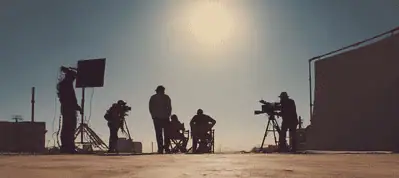
Every foreign production — feature, TV series, commercial, documentary film or commercial stills shoot — needs a national film permit before shooting in Indonesia. There is no shortcut: filming on a tourist visa is illegal and puts your footage, equipment and crew at risk of deportation and blacklisting. The application must be sponsored by a licensed Indonesian partner and filed with the film directorate, usually alongside the Indonesian embassy or consulate. Required documents typically include:
- An application letter on production company letterhead, addressed to the film directorate
- A synopsis or treatment, its intended distribution and whether it is theatrical or non-theatrical
- Your production company profile and past credits
- A full crew and cast list with passport copies (valid at least six months from entry)
- A detailed equipment list with serial numbers for customs clearance
- A shooting schedule and list of locations
- Completed application forms and passport photos for each crew member
The official processing time is around four to eight weeks, and every application passes an inter-ministerial review — submit at least two months before your shoot, and longer if your schedule includes conservation areas, which need a separate special permit. Drone filming also requires additional permits in most regions.
Journalist Visa and the C14 Film Visa
Once the permit is approved, all foreign crew apply for the appropriate visa. For most productions this is the C14 filming visa — single-entry, valid 60 days and extendable in-country to a maximum of 180. News crews apply for a journalist visa instead, cleared through the Ministry of Foreign Affairs. The visa process can only begin once the film permit exists, which is why the permit timeline drives the whole production calendar; for long shoots, a limited-stay permit (KITAS) may replace repeated extensions.
Customs Clearance and Practical Information for Filming in Indonesia
Temporary import of filming equipment is managed against the approved equipment list attached to your film permit — which is why that list, with accurate serial numbers, matters so much. A few practical points:
- Keep the equipment list final before the permit is filed — late additions mean amendments and delays.
- Carnets and temporary-import bonds are handled by your local sponsor; allow time for customs clearance on entry and exit.
- Jakarta and Bali have solid rental houses for cameras, grip and lighting — for many jobs, flying in specialty items only is cheaper and safer.
- Humidity is brutal on gear. Budget for silica, dry cabinets and covered staging on jungle and coastal shoots.
Practical notes: Bahasa Indonesia is the official language, with English widely spoken in Jakarta and Bali but a bilingual fixer essential elsewhere. The climate is tropical year-round with a dry season roughly April to October — the best window for exteriors. Beyond the national permit, many locations carry their own permits (conservation areas, temples, airports, military zones), and cultural care at temples and ceremonies is where a local producer earns their fee.
Can you film in Bali?
Yes — Bali is the most filmed island in Indonesia, but the same national rules apply. Commercial shoots of any size need the national film permit and C14 visas; there is no separate “Bali permit” that bypasses the national process. Individual temples, beaches and villages then charge their own location fees, which your fixer negotiates.
What movie was filmed in Bali?
The most famous is Eat Pray Love with Julia Roberts, filmed extensively in Ubud. Bali has also hosted countless international commercials, TV series episodes and documentaries, and doubles regularly for other tropical settings.
What is the highest-grossing Indonesian film?
The animated feature Jumbo (2025) became the highest-grossing Indonesian film of all time with more than 10 million admissions, overtaking the horror phenomenon KKN di Desa Penari (2022) — a sign of how fast Indonesia’s domestic industry is growing.
Where are most movies being filmed now?
Global production still clusters in rebate-driven hubs, but Southeast Asia is climbing fast as filmmakers chase fresh locations and lower costs — and Indonesia is central to that shift. Streaming has multiplied demand for authentic Asian settings that no backlot can fake.
How long does the film permit take?
Plan on four to eight weeks from a complete application. Permits for national parks, drones and sensitive regions add time on top, so start the process at least two months out, and earlier for wildlife or expedition projects.
Ready to Start Filming in Indonesia?
From the first location scouting recce to the last customs stamp, NEEDaFIXER’s producers and fixers manage every step of filming in Indonesia — the national film permit and visa process, location permits, casting, crews, equipment and logistics across the entire archipelago. Every production gets a dedicated producer, transparent budgets and crews who know their island. Get in touch today for a free quote and a shoot plan built around your schedule.
"*" indicates required fields